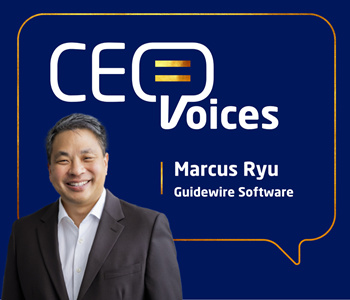
Home » Insights » CEO Voices – Interview with Marcus Ryu, co-founder and former CEO of Guidewire Software
CEO Voices – Interview with Marcus Ryu, co-founder and former CEO of Guidewire Software
Nov 13, 2025 CEO Voices , Interview , CEO voices


“Insurance operations can benefit enormously from AI, but ambitions should not exceed the actual capabilities of the technology. ”

Marcus Ryu

Marcus Ryu is an experienced technology entrepreneur, venture investor, and board director with over two decades of experience building and advising high-growth software companies. He is best known as the co-founder and former CEO of Guidewire Software, which he co-founded in 2001 and led through its IPO in 2012, and on to becoming a global leader with revenues surpassing $1 billion and a peak market value of $20 billion.


Currently, Marcus is a General Partner at Battery Ventures, leading investments in enterprise software, vertical SaaS/AI, and fintech/insurtech. He also serves on the boards of companies including Checkr, Bloomreach, Bestow, hyperexponential, Coram AI, Liberate, and Guidewire, and advises innovative startups such as Vesta Technologies and KAV.

guidewire-logo

About company

Guidewire Software is the trusted platform that enables P&C insurers to engage, innovate and grow efficiently. Serving over 570 insurers in more than 43 countries, Guidewire has delivered over 1,700 successful implementations, ranging from greenfield projects to rapid product launches. With the industry’s largest R&D investment and partner ecosystem – comprising 205+ marketplace partners and 250+ integrations – Guidewire empowers insurers with core systems, analytics, digital solutions and AI capabilities. With the support of over 2,500 employees and 26,000 trained consultants, Guidewire is fully committed to the success of P&C insurers.
Summary

The insurance industry is evolving from retrospective analysis to future-focused risk prediction. Actuaries are becoming programmers, leveraging AI, IoT, and advanced data to anticipate and prevent losses. Strategic clarity and deep respect for industry complexity are essential as insurers face rising expectations for agility and innovation. Long-term success will depend on building resilient organizations, aligning values, and delivering software that meets the sector’s unique operational demands. 

Questions of Michał Trochimczuk, President of Sollers Consulting,
to Marcus Ryu, co-founder and former CEO of Guidewire Software


Michał Trochimczuk: Last 25 years: What have been the most important technological developments for the insurance industry in the last 25 years and what significance have they had for your projects?


Marcus Ryu:  One major development has been the evolution of programming languages, particularly in how business logic is defined. Even without AI coding agents, programming today is much easier compared to working with Assembler years ago. Applications have become significantly more understandable and maintainable. 


Machine learning has also become incredibly powerful, driven by immense computational capabilities – far beyond what anyone could have imagined 25 years ago. This is especially relevant for the insurance industry, which fundamentally revolves around predicting losses. 


Artificial intelligence is just one flavor of this broader transformation. 


Another key development is machine-to-machine connectivity, which allows data to be transferred between systems at a very low cost. While this is now taken for granted, 25 years ago it was more of a dream than a reality. 


Mobile devices have also emerged, but their impact on the insurance industry has been relatively limited compared to other sectors. 

"We told people: you won't get rich, your mom won't understand what you're doing, and it's going to be hard work. And somehow, that worked."

Michał Trochimczuk: Current challenges: The world is currently facing numerous geopolitical, economic and environmental challenges. Which do you consider to be the most important from your perspective? How are you tackling them?  


Marcus Ryu: We are facing a new kind of fragility. 


For a long time, we believed that the barbaric past – marked by wars, conflicts, communism, and fascism – was behind us. It felt obvious and unquestionable that those times were over. But now, that certainty is gone. The basic principles we relied on have started to erode. 


This shift is deeply connected to what I see as an exhausting and perhaps unresolvable cultural war. And that worries me the most – not just as an entrepreneur, but also as a parent and a husband. 


In response, I urge the organizations I am involved with to be truth-seeking, regardless of the turbulence happening around us. 

Michał Trochimczuk: Next 25 years: What changes will have the greatest impact on the insurance industry in the future? What do you expect for your projects? What role will technological developments such as AI, IoT, quantum computers, etc. play?


Marcus Ryu: In the future, insurance actuaries and underwriters will focus much more on the future than on the past. Their role will evolve to more computer-enabled analysis, which will require them to become data scientists and programmers. 


Companies that master this shift will have a significant advantage. The skills and ability to do this well will become increasingly important. 


Another major change will be in how insurers identify risks and prevent losses. With the growing availability of data and sensors, there's much more information that can be used to warn people and help them prepare. This opens up new possibilities for proactive risk management. 


To put it in perspective, the credit scoring systems used in banking are quite basic compared to the complexity involved in actuarial modeling. 

Michał Trochimczuk: Generative AI Impact: AI and generative technologies are advancing quickly. How do you see them impacting underwriting, claims, and customer service – and how should insurers prioritize their adoption?


Marcus Ryu: AI is already reducing friction in areas that traditionally relied heavily on people and manual processes. Its core strength lies in translation. My mother was a Korean-English translator, and now that kind of services are free of charge. 


AI is bridging differences in language, data formats, and systems --- reducing semantic impedance of many different types. Where insurers once struggled with unstructured data, AI can now structure it, enabling systems to communicate with human-mediated translation. 


I don’t believe AI will solve problems like curing cancer, at least not directly, but within insurance its value is very real. Half of the effort of Guidewire implementations, for example, comes from system integrations, and AI has the potential to simplify them. It allows insurers to understand customer needs in real time and connect those needs directly to backend systems. This not only improves efficiency but creates a far superior customer experience – one that could even become empathic over time. 


Ultimately, AI is unlocking the possibility of true omni-channel engagement, something insurers have long aspired to but struggled to achieve. That’s where I see its most immediate and transformative impact. 

"We knew we had to be ten times better, because switching core systems in insurance is incredibly demanding."

Michał Trochimczuk: What are the factors that have made Guidewire successful?


Marcus Ryu: Guidewire’s success came down to three core principles: deep focus, fundamental respect, and clear differentiation. 


We had a deep focus on property and casualty (P&C) insurance, which is fundamentally different from life or health insurance. In the early 2000s, few believed that investing in a core system tailored to a single industry could be venture investable. But we understood the complexity of enterprise software in insurance – systems evolve over decades, unlike the rapid build-and-replace cycles common in Silicon Valley. 


It was critical to define a strategic frame early on: what we aspired to do, and just as importantly, what we chose not to do. That clarity was essential. Unlike the Silicon Valley approach of constantly pivoting, we held firm to our direction. From day one, we committed to building a standard, upgradable software product for P&C insurers. It sounded obvious, but wasn’t – especially when considering large, complex insurers. 


We made only one major strategic shift: evolving from on-premise to cloud, which of course wasn’t a viable option in the early 2000s. 

We deliberately excluded life and annuity, as well as self-insurers like workers’ compensation. At one point, we thought self-insurers were similar enough to include. Guidewire won several of them and was excited – but it turned out to be a mistake. The differences were too great. We ended up returning every dollar and stepping back to refocus. That was a hard moment emotionally, especially since selling was so difficult and every dollar mattered. But I’m proud of how we handled it, especially around 2005. 


We always maintained a plain proposition – not tailored to investors, but grounded in a clear market diagnosis. We made many mistakes, but not this one. Strategic clarity and a simple, focused proposition were key. 


At the time, Silicon Valley was in the midst of the internet boom. There was a widespread excitement in a magical future unlocked by technology – somewhat similar to what we’re seeing now with AI. But overreaching and overpromoting those dreams led to a massive crash.  That why today I emphasize to insurance companies that their operations can benefit enormously from AI, but their ambitions should not exceed the actual capabilities of the technology. 


Back to Guidewire, our culture was defined very differently from companies of the boom era. We were highly ambitious but not primarily driven by personal wealth or ego. Our goal was to build quality software, work shoulder-to-shoulder with great colleagues, and solve real problems in the sector. 


We told people: you won’t get rich, your mom won’t understand what you’re doing, and it’s going to be hard work. And somehow, that worked. The founders led by example – they worked harder than anyone and offered others the same path. 


It was also a moment in time when the industry needed a product like ours. Venture capital was expensive and often unfair to founders and employees. Back then, we didn’t think much about it – but now, I see it differently. 

Michał Trochimczuk: What role did company culture and founder mindset play in navigating Guidewire’s success?


Marcus Ryu: When I talk to founders today, I emphasize three things: 


  • Strategic clarity 
  • Respect for the industry 
  • Motivation for the right reasons – values alignment with colleagues and a commitment to serving the customer 


That’s how Guidewire succeeded, even though it took a long time. 


Building that strategic frame wasn’t immediate, but we had clarity about the destination. We knew we had to be ten times better, because switching core systems in insurance is very demanding. 


I never accepted the idea that insurers are less innovative than others, and after spending considerable time in insurance operations I grew in great respect for their professionalism and competence. That said, many insurance organizations are more bureaucratic than they need to be, which makes innovation harder. 


Companies like Progressive, Geico, and USAA built their own systems and gained massive advantages in the 1980s. But by 2010, that wasn’t enough. Differentiation required a division of labour – organizations needed to focus on what made them unique, not on building everything themselves. 


There was a lot of debate around whether to build custom frameworks like React or Angular or go with standard solutions. By 2010, the answer was clear: standardization was the way forward. 


Companies often lose when they swing to extremes. You can’t go from 100% custom-built to fully standardized overnight. That kind of transition takes time and care. 

CEO Voices Interviews

CEO Voices CEO Voices – Interview with Isabelle Le Bot CEO of La France Mutualiste
Shinichiro-Funabiki-ms&ad
CEO Voices CEO Voices – Interview with Shinichiro Funabiki, Representative Director, President and Chief Executive Officer, Group CEO, MS&AD Insurance Group Holdings
marcus-ryu-guidewire-ceo
CEO Voices CEO Voices – Interview with Marcus Ryu, co-founder and former CEO of Guidewire Software
ken-norgrove-intact-insurance
CEO Voices CEO Voices – Interview with Ken Norgrove, CEO of Intact Insurance UK&I
AI, CEO Voices CEO Voices – Interview with Jean-Daniel Laffely, CEO of the Vaudoise Insurance Group
AI, CEO Voices CEO Voices – Interview with Simon Wilson, CEO of Markel Insurance
andrew horton
AI, CEO Voices CEO Voices – Interview with Andrew Horton, CEO of QBE
dr Frank Walthes interview pic
AI, CEO Voices CEO Voices – Interview with Prof. Dr. Frank Walthes

Contact Us

Michał Trochimczuk
Michał Trochimczuk
President